Are Your PPC Campaign Structures Ready for AI Search?

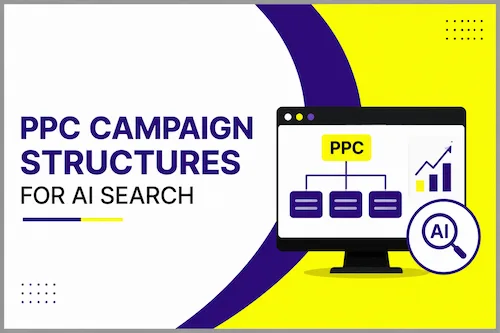
AI Search Trends are changing how people research before clicking an ad. Searchers ask longer questions, compare options, and arrive with more context. The old habit of creating a separate campaign for every small keyword theme can create too many isolated pockets of data. Strong campaign structures need to balance control with enough data for automated bidding to learn.
Why do PPC Campaign Structures need to change?
Advertisers once built campaigns around keywords, match types, products, locations, and audiences. That made sense when queries were strong intent signals. AI can now interpret broader meaning across complex searches. A person may move from a general question to a feature, price, or comparison query without following the neat funnel we planned. Search Engine Journal highlights this shift and recommends consolidation where business needs do not require separate control.
Consider an accounting software company. One buyer searches “accounting software for small businesses.” Another asks an AI-assisted search about invoicing, GST, payroll, and pricing. Both may be valuable prospects. Splitting every theme into tiny campaigns can make the data too thin. Good campaign structures should follow business needs, not simply the number of keywords.
Should you consolidate PPC Campaign Structures?
Consolidation does not mean putting everything into one campaign. Separate campaigns still make sense when a product needs its own budget, a service has a different performance target, or creative and compliance requirements differ. For closely related goals, however, combining activity can give automated bidding more useful conversion data.
I have seen accounts with twenty or thirty campaigns competing for limited budgets. Several campaigns had very few conversions. The bidding system had little evidence to learn from. Better structures often come from removing unnecessary walls between similar goals. The goal is enough data for decisions.
What role does conversion data play in PPC Campaign Structures?
Conversion tracking is now part of campaign architecture, not just reporting. If every lead is treated as equal, the platform may value a weak enquiry as highly as a serious prospect. That can push budget toward unprofitable actions. Strong PPC Campaign Structures connect campaigns with meaningful conversion actions and realistic values.
Imagine a B2B company selling software. One demo request could become a ₹5 lakh customer. Another lead may never answer the sales team’s call. Counting both as equal conversions hides that difference. Passing useful value signals gives automated bidding better information about what the business actually wants. Search Engine Journal also notes that fragmented campaigns can struggle without enough conversion volume.
A common mistake is chasing a low CPA without checking lead quality. Low-cost leads are not automatically good leads. Before changing the structure, check which actions create revenue, which assist sales, and which are simply noise.
How should ads and landing pages support PPC Campaign Structures?
AI Search Trends also affect creative. Buyers may discover your brand after researching elsewhere. When they click, they may already know the category, price range, or features they want. Your ad should not make them start the research again. Each headline, description, image, and landing page should make sense on its own.
A digital marketing freelancer could create messages around SEO, lead generation, local visibility, and measurable results. The landing page should support those claims with proof and a clear next step. This approach makes PPC Campaign Structures more flexible because assets can serve related intent instead of one narrow keyword path.
Do not create endless ad variations to fill an asset count. Give the platform meaningful choices. Test different benefits, proof points, objections, and calls to action. Search Engine Journal notes that AI-assisted assets can help match creative to user signals, while human oversight is still needed for brand and message constraints.
What mistakes should you avoid when building PPC Campaign Structures?
One mistake is keeping an old account structure simply because it worked years ago. Another is splitting campaigns whenever a new keyword appears. A third is combining unrelated goals because automation encourages consolidation. Both extremes can hurt performance. Review each campaign by asking whether it needs separate budget, has a different business target, receives enough conversion data, and represents a genuinely different customer need.
The best PPC Campaign Structures are not the most complicated ones. They give the platform useful data while protecting the controls the business genuinely needs. AI can handle pattern recognition and optimisation where it performs well. Humans still decide which customers matter, which products deserve priority, and which claims the brand can support.
For a business owner, review the account from the business side first. Look at profit, lead quality, sales value, and customer intent. Then inspect campaign settings. Perfectly named campaigns do not mean the account is healthy. Your PPC Campaign Structures should make it easier to spend money on valuable customers.
AI does not make campaign strategy less important. It exposes poor structure faster. Buyers bring more context into searches, while advertising platforms use more signals to decide where ads appear. Strong PPC Campaign Structures give those systems room to learn without giving up sensible human control.
If you manage paid search yourself, start with an account audit. Find campaigns with similar goals, weak conversion volume, or conflicting targets. Test consolidation and measure the result. A good digital marketing freelancer would not rebuild an account just to make it look modern. They would change what limits performance and keep what works.
The practical lesson from current AI Search Trends is simple. PPC is moving away from rigid keyword paths and toward intent, conversion quality, flexible creative, and business-focused control. The right PPC Campaign Structures will not look identical for every company. They should fit the economics of the business and give automation enough useful information to make better decisions.