Is Your AI Search Report Showing Growth or Just Creating Confusion?

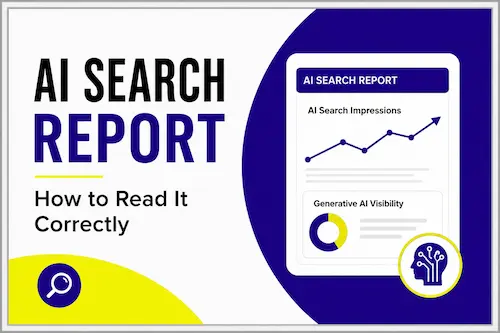
Many website owners check Google Search Console every week. They look at clicks, impressions, and rankings. Recently, another metric has started getting attention. That is the AI search report.
At first glance, the numbers may look exciting. More impressions often feel like better performance. But that isn’t always true. Reading an AI search report without context can lead to the wrong conclusions.
Why Does the AI Search Report Matter?
Search is changing. People no longer see only the traditional list of blue links. Search engines now generate AI-powered answers before showing regular results. This changes how websites receive visibility.
The AI search report helps you understand how often your content appears inside these AI-generated experiences. That is different from Traditional Search Impressions, where users simply saw your page in the regular search listings.
For businesses investing in digital Marketing, this information adds another layer to performance tracking instead of replacing existing SEO metrics.
Think of it like opening a new shop inside a busy mall. Your original store still exists outside, but now customers may also notice you while walking through the mall. Both locations create visibility, but they work differently.
What Can an AI Search Report Actually Tell You?
The biggest mistake is assuming every impression means someone visited your website.
Imagine someone searches for “best email marketing software.” Google’s AI answer summarizes several websites and briefly references yours. Your website gains an AI Impression, even if nobody clicks.
That does not mean the report is useless.
Instead, the AI search report shows where your content is becoming part of AI-generated answers. This can reveal growing generative AI visibility even before traffic starts increasing.
A healthy AI search report may indicate that Google trusts your content enough to include it in AI responses. Trust usually develops over time through helpful content, topical authority, and consistent publishing.
This is why experienced marketers never judge success using one number alone.
How Should You Read an AI Search Report Without Misleading Yourself?
Treat the AI search report as one piece of the puzzle.
Compare it with clicks, conversions, engagement, and organic traffic. If AI search impressions increase while conversions remain stable, your content may simply be getting discovered by more people.
If both impressions and clicks improve, your content is likely earning stronger visibility.
A useful habit is comparing your AI search report every month instead of every day. AI search experiences are still evolving, so daily fluctuations rarely tell a meaningful story.
Many marketers also compare their AI search report with a Generative AI Report from third-party SEO platforms. Although the numbers may differ, patterns often become easier to spot.
One client I worked with saw almost no change in rankings for three months. However, the AI search report showed steady growth. A few weeks later, organic traffic also increased. The early visibility appeared before the traffic did.
That does not happen every time, but it shows why these reports deserve attention.
What Mistakes Do Businesses Commonly Make?
Most reporting problems come from interpretation rather than the data itself.
Some of the most common mistakes include:
• Treating every AI Impression as a website visit.
• Ignoring Traditional Search Impressions completely.
• Comparing one week’s data instead of monthly trends.
• Chasing AI visibility while neglecting content quality.
• Measuring impressions without tracking leads or sales.
These mistakes often create unnecessary panic.
For example, a business owner may see lower clicks but higher AI search impressions. They immediately assume SEO is failing. In reality, users may have received quick answers from AI while still becoming familiar with the brand. Brand awareness is difficult to measure using clicks alone.
A digital marketing freelancer who understands reporting will explain the complete picture instead of focusing on a single graph.
How Can You Improve Your AI Search Report Naturally?
There is no button that increases your AI search report overnight.
Search engines usually prefer content that answers real questions clearly. Pages that explain concepts, solve problems, include examples, and stay updated tend to earn better generative AI visibility.
Simple writing often performs better than complicated explanations.
Instead of writing only for keywords, write for people trying to solve a problem. If someone searching for information leaves with their question answered, search engines notice those quality signals over time.
Keep older articles updated. Improve headings. Add practical examples. Remove outdated information. These small improvements often help both Traditional Search Impressions and AI visibility.
For businesses investing in digital Marketing, the goal should never be collecting impressions alone. The real objective is attracting qualified visitors who eventually become customers.
The AI search report should become part of your monthly SEO review, alongside traffic, conversions, engagement, and revenue. Looking at all these metrics together creates a much clearer understanding of performance.
As AI-powered search continues to evolve, marketers who understand the meaning behind the numbers will make better decisions than those who simply celebrate higher impressions. The AI search report is not replacing traditional SEO reporting. It is adding another layer of insight that helps explain how your content is being discovered in modern search experiences.
When you read the AI search report with the right expectations, it becomes a valuable decision-making tool instead of just another dashboard full of numbers.