Is AI-generated Content Hurting Your Website Rankings?

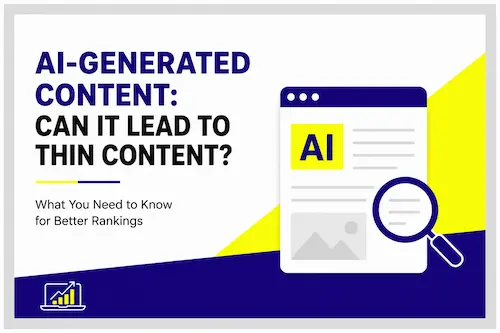
Many website owners publish new articles every week. They expect more traffic, better rankings, and more leads. Instead, they see little or no improvement. One reason could be the way AI-generated content is being published.
Recent discussions across the SEO industry suggest that Google is becoming better at identifying pages that offer little value. The issue is not simply AI-generated content. The real problem is thin content that adds nothing new for readers.
I have audited websites where hundreds of articles were published within a few weeks. The writing looked clean. Grammar was perfect. Yet almost none of the pages ranked well. After reviewing them, one pattern became obvious. Most of the AI-generated content repeated information already available on hundreds of other websites.
Why Does AI-generated Content Become Thin Content?
Think of your website like a restaurant. Customers do not return because the menu looks nice. They return because the food gives them something worth paying for.
The same idea applies to AI-generated content. If an article simply repeats facts without adding experience, examples, or useful advice, readers leave quickly. Search engines notice those signals over time.
That is why thin content is a problem. It does not answer questions better than competing pages. It fills space instead of solving problems.
One common example comes from local businesses. A dental clinic might publish ten articles about teeth whitening. Every article explains the same process using different words. Even if every page contains AI-generated content, the real issue is that none of them offers a unique reason for someone to read them.
Instead, a better article could explain treatment costs in the local area, common mistakes patients make, or after-care tips based on real experience.
How Can You Make AI-generated Content More Useful?
I see many businesses treat AI-generated content as a finished product. That approach usually fails. I prefer treating it as the first draft.
After generating a draft, improve it by adding:
• Real client examples or case studies.
• Personal observations from actual campaigns.
• Original screenshots, charts, or photos.
• Practical checklists readers can follow.
• Local insights that competitors often miss.
This simple process transforms ordinary AI-generated content into something readers actually find helpful.
For example, a digital marketing freelancer writing about local SEO can include challenges faced by businesses in Chennai instead of repeating general ranking tips. That extra context makes the article more trustworthy.
What Mistakes Should You Avoid?
One mistake is publishing articles without reviewing them. I have seen websites publish hundreds of pages where every introduction sounds nearly identical. Readers notice this immediately.
Another mistake is chasing keyword numbers instead of reader satisfaction. Repeating AI-generated content again and again does not automatically improve SEO. Keywords should fit naturally into the conversation.
Many businesses also ignore fact-checking. Sometimes AI-generated content includes outdated statistics, incorrect product details, or misleading advice. Even small factual errors reduce credibility.
Some website owners create separate articles for every tiny keyword variation. The result is multiple pages covering the same topic. That often creates Thin Content because none of the pages goes deep enough to deserve its own ranking.
Another overlooked issue is skipping human editing. Even well-written AI-generated content benefits from someone who understands the audience. Small edits often make a big difference in clarity and usefulness.
What Would an Experienced Digital Marketing Freelancer Recommend?
From my experience in digital Marketing, successful websites rarely depend on automation alone. They combine efficiency with expertise.
When I create AI-generated content, I always ask one simple question before publishing: “Would I bookmark this page if I were searching for this answer?”
If the answer is no, the article needs more work.
I also compare my article with the top-ranking pages. Not to copy them, but to identify missing information. If every article explains the basics, I include practical examples, lessons from campaigns, or common customer questions. That makes AI-generated content more useful and less likely to become Thin Content.
A digital marketing freelancer should also remember that clients expect results, not just content volume. Publishing fewer, stronger articles usually produces better long-term performance than uploading dozens of weak pages.
Quality also improves when businesses update existing articles instead of creating new ones every week. Refreshing statistics, adding fresh examples, and expanding useful sections often delivers better SEO results than publishing another piece of AI-generated content on the same subject.
Can AI-generated Content Still Help Your SEO?
Yes, it can. AI-generated content is a tool, not a ranking factor. The real question is whether the finished page genuinely helps someone solve a problem.
When AI-generated content includes original insights, accurate information, practical advice, and real experience, it becomes far more valuable than a generic article written only to target keywords.
Businesses that focus only on publishing faster often create Thin Content without realizing it. Those that focus on helping readers usually build stronger authority over time.
Good SEO has always rewarded useful content. That principle has not changed. If every article answers real questions, shares practical experience, and gives readers a reason to stay on the page, your website has a much better chance of earning long-term visibility.
Use AI-generated content to save time, not to replace thinking. Combine it with your expertise, your customer knowledge, and your experience in digital Marketing. That combination creates content people trust, search engines understand, and businesses benefit from. Whether you run a company or work as a digital marketing freelancer, helpful content will always outperform content created only to fill pages.